A Miraculous Survival on Everest: Sherpa Guide Cheats Death After Going Missing for Days
Mount Everest has once again become the stage for a story that seems written on the thin line between survival and the impossible.

Mount Everest has once again become the stage for a story that seems written on the thin line between survival and the impossible. This time, the protagonist is Hillary Dawa Sherpa, an experienced 52-year-old guide who vanished on May 29th during an expedition's descent in one of the most perilous zones on the roof of the world. His last known contact was in the area known as the Yellow Band, located above Camp III at an altitude of over 7,000 meters a place where oxygen levels plummet and any misstep can become an irreversible death sentence.
From that moment on, a search got underway, plagued by uncertainty and relentless weather conditions. Rescue teams made several unsuccessful attempts to locate him, while the passing days wore hope down to a fragile thread. The total lack of signs led his teammates and family to brace for the worst. In his inner circle, traditional Sherpa funeral rites were even initiated as a final farewell to what appeared to be an inevitable loss on the mountain.
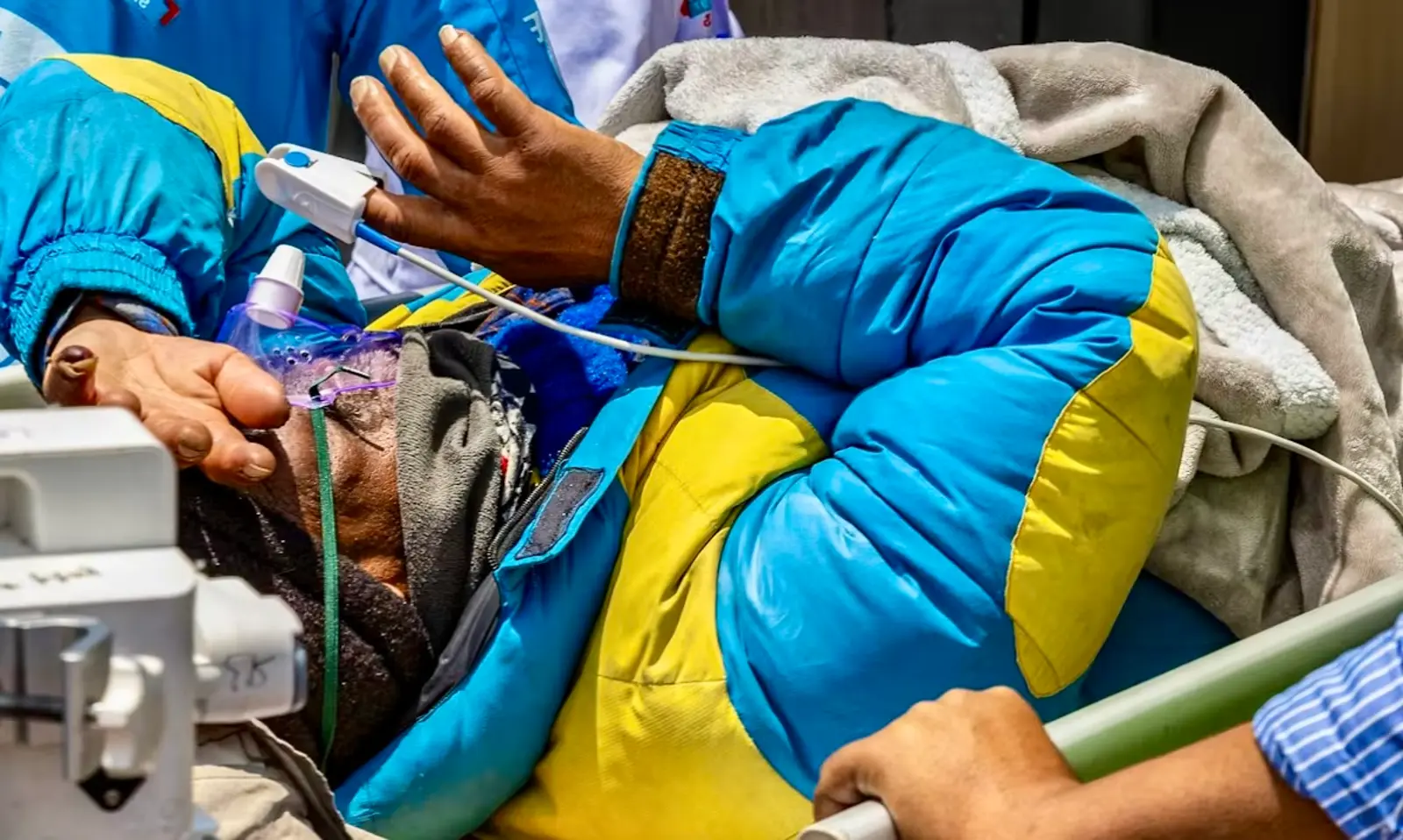
However, the narrative took an unexpected turn on June 4th. A team from the Sagarmatha Pollution Control Committee, operating near the glacier, spotted movement close to the Khumbu Icefall, just above Base Camp. What they found defied all expectations: the guide was there, visibly weakened and moving with extreme difficulty practically crawling across the ice but still alive. The discovery immediately triggered an evacuation protocol, and he was airlifted by helicopter to Kathmandu for urgent medical care.
Subsequent reports have allowed officials to piece together the guide’s ordeal during his disappearance. He reportedly spent about a week completely alone in one of the most hostile environments on Earth. During this time, he managed to survive without any outside assistance, rationing minimal supplies he had on him, including small food reserves like chocolate and instant coffee powder. He also melted snow and ice for water in an environment where dehydration sets in at a critical pace. To make matters worse, he endured an especially harrowing episode where he was trapped for over two days in a crevasse before managing to extricate himself.
Though serious, his condition upon arriving in the Nepalese capital was stable. Doctors diagnosed frostbite on his hands and extremities, severe dehydration, and injuries stemming from prolonged exposure to extreme cold. A suspected fracture of the right femur further complicates his clinical picture. Despite everything, the guide arrived at the hospital conscious, and his initial recovery has been deemed favorable adding an even greater sense of wonder to the case given the circumstances of his discovery.
The story, however, did not end with his rescue. In the days that followed, Dawa Sherpa’s family publicly expressed their outrage, claiming that the search operation was launched too late. According to their statements, the response from authorities and the expedition organizer was not swift enough during the critical hours following his disappearance. They even alleged a double standard in such situations, suggesting that the mobilization of resources would have been vastly different had the missing climber been a foreign client rather than a local guide. These accusations have led to formal complaints, and Nepalese authorities are currently reviewing the incident to determine whether protocols were properly followed.
The case has drawn widespread international attention due to its extraordinary outcome. Mountaineering and high-altitude medicine experts emphasize that surviving so many days on Everest without support is nothing short of miraculous, given the lethal combination of hypoxia, sub-zero temperatures, and treacherous terrain. In this context, numerous specialists have described the guide's survival as an exceptional phenomenon that pushes the absolute boundaries of human endurance.
As he continues his recovery at a specialized medical facility in Kathmandu, Hillary Dawa Sherpa’s story has become a symbol of resilience on the world's most unforgiving mountain. His case reopens the debate surrounding safety on high-altitude expeditions and the fragility of life where nature dictates its own rules without compromise. On Everest, every story has an unpredictable ending, but rarely does one feature such an unexpected return from the very brink of the abyss.