Sheinbaum presents Olinia: Mexico’s first homegrown electric vehicle aims to launch a new industrial era
With the official unveiling of Olinia, Mexico has taken a symbolic step toward building its own automotive and technological capacity.
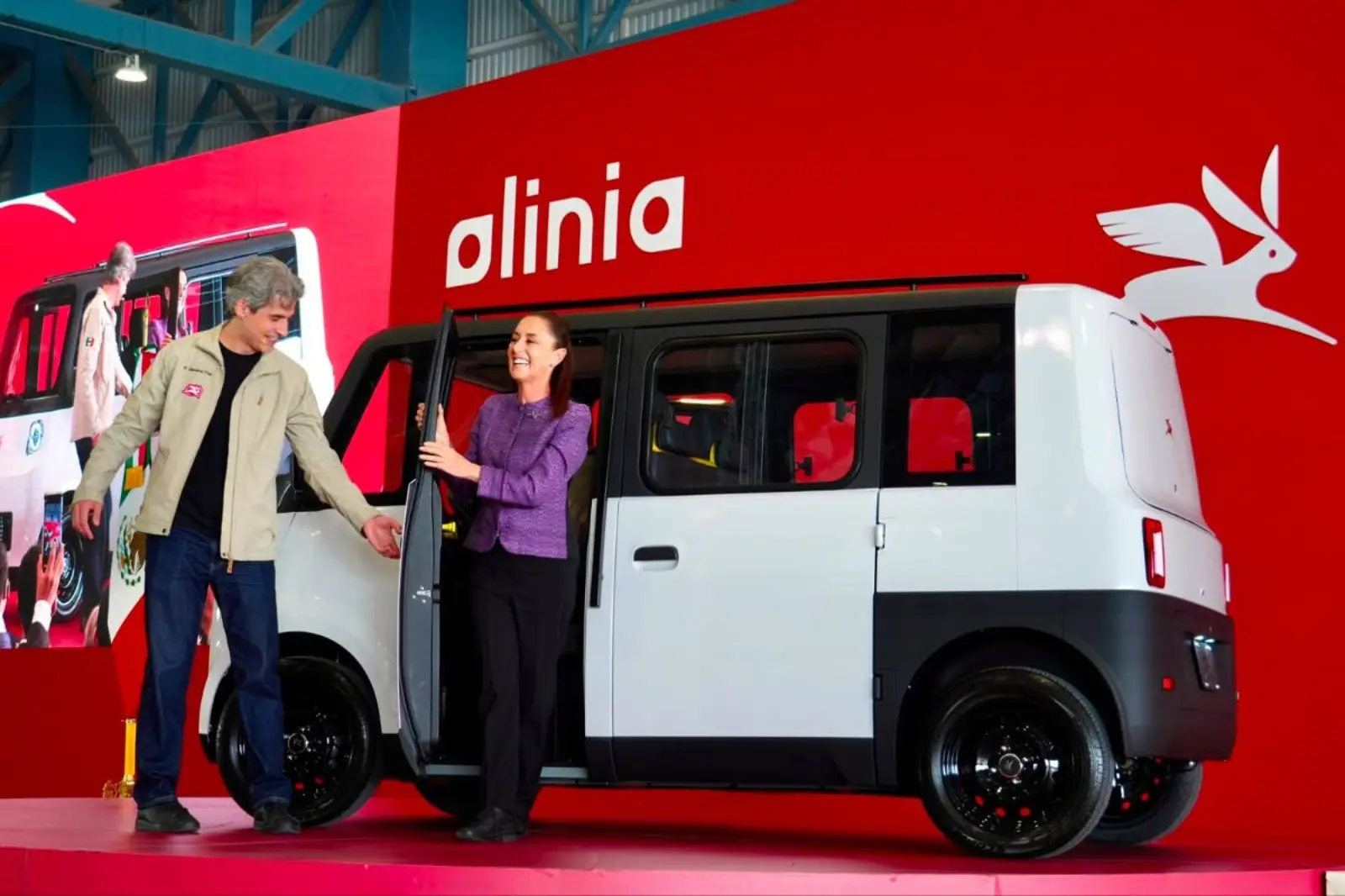

With the official unveiling of Olinia, Mexico has taken a symbolic step toward building its own automotive and technological capacity. The first electric vehicle developed in the country reflects President Claudia Sheinbaum’s ambition to anchor industrial value creation more firmly within Mexico.
Mexican President Claudia Sheinbaum on Sunday presented the prototype Olinia 1, the first electric vehicle developed in Mexico, marking its transition into the production phase. Market launch is scheduled for the summer of 2027, with a starting price of around 150,000 pesos (approximately €7,460 / $8,100).
The presentation took place inside a hangar at the Santa Lucía Military Air Base in the State of Mexico. Sheinbaum herself took the wheel of the vehicle, accompanied by engineers, researchers, and project officials. The compact city car can seat up to six passengers and is also adapted for the transport of people using wheelchairs.

“It is proof that Mexico can be more than just a recipient of investment. We can generate knowledge, develop technology, design solutions, and create value from our own capabilities,” Sheinbaum said during the presentation.
According to the government, Olinia is intended to mark the beginning of a broader national electromobility strategy. The project is based on cooperation between state institutions, universities, and research centers, with the long-term goal of building a domestic industrial base for electric mobility.
Technically, the vehicle is designed for urban use. It features a 14.7 kilowatt-hour battery, a range of over 125 kilometers per charge, and a top speed of 50 kilometers per hour. Operating costs are estimated at around 49 centavos (€0.024) per kilometer—roughly five times cheaper than a comparable gasoline vehicle—which could translate into annual savings of up to 50,000 pesos (approximately €2,485 / $2,700).
At the end of the presentation, Sheinbaum addressed the development team with a brief statement: “Mission accomplished.” Project coordinator Roberto Capuano Tripp also announced the next phase: Olinia Cargo, a version designed for light freight transport, which is expected to be unveiled in the coming months.
The vehicle is being developed at the Olinia Design Center at the Technological Institute in Puebla. More than one hundred specialists from the National Polytechnic Institute and Mexico’s National Technological Institute are working on advancing the project.
The initiative is based on a simple urban logic: around 70 percent of Mexico’s population lives in cities, and most daily travel distances are under 30 kilometers. Olinia is therefore not intended as a long-range vehicle, but as an affordable solution for everyday urban mobility and short-distance commercial transport.
Although Mexico is among the world’s largest automotive producers and the sector accounts for a significant share of its GDP, production has so far been dominated by foreign brands. With Olinia, the country aims to shift from being primarily a manufacturing hub to a nation that also develops and industrializes its own technologies.